



#Fun Fridays
Growing Words, Growing Minds
Why Learning New Words Matters in the Preschool Years
Have you ever noticed how quickly preschool children pick up new words? One day they may not know a word, and the next day they are using it in their play, conversations, and stories!
Building vocabulary is an important part of early childhood development. Every new word a child learns gives them another way to understand their world, express their ideas, and connect with others.
Words Help Children Make Sense of Their World
Preschoolers are naturally curious. They want to know what things are called, how they work, and why things happen. Introducing new vocabulary helps children put words to their observations and experiences.
Instead of simply saying, “Look at that bird,” we might say:
“Look at that enormous bird! It has colorful feathers and is perched on the branch.”
Words such as enormous, colorful, and perched give children more precise ways to describe what they see.
Vocabulary Builds Strong Communication Skills
The more words children know, the easier it becomes for them to communicate their thoughts, feelings, questions, and needs.
A child who knows the words frustrated, worried, or disappointed has more ways to tell an adult how they are feeling. A child who knows words such as enormous, tiny, slippery, or rough can give more detailed descriptions of their experiences.
Vocabulary gives children the tools to tell their stories.
Books Are Wonderful Word Builders
Reading aloud is one of the best ways to introduce children to new vocabulary. Books expose children to words they may not hear during everyday conversations.
While reading, pause occasionally to talk about an unfamiliar word:
- “The character was exhausted. What do you think that means?”
- “The caterpillar was enormous. Is it bigger or smaller than the other caterpillars?”
- “The ground was damp. How do you think it felt?”
Children do not need to memorize every new word. Hearing words repeatedly and hearing them used in meaningful situations helps vocabulary grow naturally.
Play Is a Powerful Learning Opportunity
Play provides countless opportunities for children to use new words.
During block play, children might learn words such as balance, structure, tall, and foundation.
In the dramatic-play area, they may use words such as customer, ingredients, appointment, or community.
During outdoor exploration, children might discover words such as observe, investigate, texture, and habitat.
When adults join children's play and introduce vocabulary naturally, children have a reason to use the new words right away.
Try This at Home: “Word of the Day”
Choose one interesting word connected to something your child is experiencing. Talk about what it means, use it in a sentence, and look for opportunities to use it throughout the day.
For example:
Word: Curious
“Curious means wanting to learn or know more about something.”
You might say:
- “You were curious about what was inside the box.”
- “Let's be curious scientists and investigate!”
- “What are you curious about today?”
At St. Paul’s Preschool...
We intentionally surround children with rich language throughout the day. We talk, read, sing, ask questions, describe, wonder, and listen. We introduce new words during lessons, conversations, stories, classroom experiences, and play.
Most importantly, we make learning new words fun! When children discover a new word, they are not simply learning a word—they are gaining another way to think, communicate, understand, and connect with the world around them.
At St. Paul’s Preschool, we believe that growing a child’s vocabulary is another way of helping their world grow!
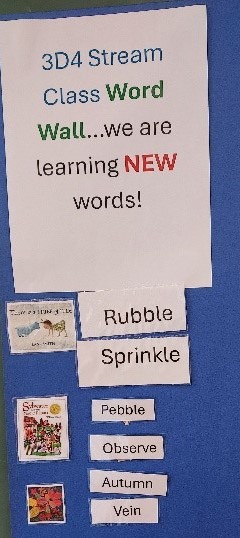
In the 3 Day 4-year-old Stream class, we have learned new vocabulary words found in our stories we read each week. We practice using these words throughout the day and review the ones we have previously highlighted!